Farm issues enter House race
By: RICHARD ROTH
Hillside Independent 10/3/06
HILLSDALE-Farmers can be sure politicians will voice their support for family farms, according to Columbia County Farm Bureau President Eric Ooms. But that doesn't mean they will always deliver the goods.
"Nobody ever says: I hate agriculture," says Mr. Ooms. "It's just a matter of how much they back up what they say they're going to do."
About 30% of Columbia County was farmland as of the most recent census in 2002, when the county had 498 farms, 9% fewer than in 1997. Columbia County farm production expenses totaled $54,393,000 that year, with a net cash income of $1,853,000; the average farm size was 240 acres.
 Rensselaer County lost 2% of its farms during the same 5-year period, with 549 farms averaging 168 acres still in operation in 2002. Rensselaer farmers had a net income of $8,581,000 on production expenses of $21,848,000.
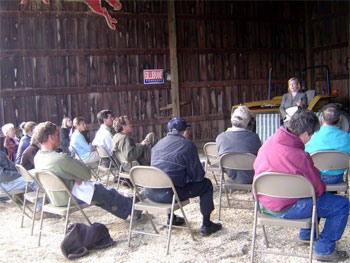
So far this election season, U.S. Congressman John Sweeney (R-20th) has not issued any position papers specifically related to agriculture. But his challenger, Democrat Kirsten Gillibrand, issued a policy statement at a meeting in Hoosick Monday, September 25, outlining her plan "to protect farmers and their families."
Ms. Gillibrand says that if elected, she would support legislation to:
*Increase tax relief for energy consumed in farm production
*Enact tax incentives to perfect, develop and implement alternative energy sources such as bio-fuels, fuel cells, wind, solar and hydropower.
*Create incentives for farm equipment manufacturers to increase energy efficiency for fuel-burning and electrical equipment.
Mr. Sweeney had not responded to requests via phone and e-mail for comment on Ms. Gillibrand's proposals as The Independent went to press Monday afternoon. Rob Doherty, Deputy Press Secretary in Mr. Sweeney's Washington office, said Friday that Mr. Sweeney was not available to comment on the Gillibrand statement.
According to Mr. Ooms, farmers are reeling from the recent dramatic increase in energy costs, with no corresponding increase in the price they're paid for their produce. And he says it's time for the government to step in. "Energy prices are so high that it throws everything out of whack," says Mr. Ooms. "The impact is not only on dairy; fruit and vegetable farmers are getting hammered, too."
Mr. Ooms said Vermont has spent $8.5 million on subsidies for dairy farmers this year, and that Connecticut has taken similar steps. Retail prices have risen considerably, but wholesale prices have been stagnant for many years, in spite of increases in farmers' outlays for seed, equipment, labor and fuel.
While the price of milk is currently around $13 per hundredweight, it was as low as $11 for several months earlier this year.
Ms. Gillibrand faults Mr. Sweeney's voting record on several key issues related to farming in upstate New York. According to a statement issued by the Gillibrand campaign, Mr. Sweeney voted against a number of bills that would have helped farmers, including increasing investment in renewable fuels and that he voted for "billions of tax cuts for Big Oil" (HR 975, April 20, 2005 and HR 6, July 28, 2005), as well as against long-term bankruptcy protection for family farmers (HR 2673, January 28, 2004) and against country-of-origin labels for meat products (HR 2673, July 14, 2003). The Gillibrand campaign also said he voted to close 713 of the country's Farm Services Agency offices (HR 2744, October 20, 2005) and against $6 million in increased funding for the Farmer's Market Promotion Program, which the Democrat's campaign calls "a crucial program for small-scale producers" (HR 4766, July 13, 2004).
The Gillibrand campaign also says Mr. Sweeney was given a 17% approval rating, the second lowest in the New York delegation, by the National Farmer's Union.
Mr. Sweeney, Ms. Gillibrand and all other candidates for state and national office were recently sent a questionnaire by the Columbia County Farm Bureau, asking them for 150-word policy statements on a number of issues, including milk pricing and immigration. The results were being collated over the weekend, according to Mr. Ooms, but they had not been made available as of Monday afternoon.
Most of the issues have to do with finances, in one way or another. "Personally, we would prefer to see things that would put more money in farmers' pockets," said Mr. Ooms. "Another thing is to not over-regulate us to death, which would save us money."
Mr. Ooms said farmers have been helped out by the recent drop in gasoline prices, but that he wasn't sure the prices could be counted on to remain at current levels.
"I don't know who's in charge," said Mr. Ooms, "but if the gas price spikes back up on November 15, I'm not going to be very happy."
Mr. Ooms said he tries not to talk about any candidate in particular, because it's a "no-win" situation. "I try to play it straight down the middle," he said. "Quite frankly, where one side may help you on one issue they may hurt you on another, and that's true of both parties."
Other farmers who were contacted regarding the fall election declined to be interviewed altogether. "We just don't want the publicity, because we have to deal with too many of the [government] agencies," said one northern Columbia County farmer.
To contact reporter Richard Roth, e-mail [email protected].